Written Waves - August 2026: The rhythm of reflection
Step into the August edition of Written Waves, where Bert Russell invites you to explore his unique perspective on life. Through his reflective and honest observations, he shares insights shaped by nonlinear thinking, sensory experiences, and a dyslexic mind. Join him as he weaves narratives connecting life's journey to the metaphoric waves of the lake and the essence of H2O lifestyles, inspiring peace, adventure, and a deeper understanding of spatial and human geography.

Waves of introspection
In this August series, Bert Russell delves into reflective storytelling, drawing parallels between the world's observations and the tranquil yet powerful nature of waves. Discover how the ever-changing lake environment mirrors our inner landscapes, encouraging moments of quiet contemplation and profound understanding. Each story is crafted to transport you to a place of peace, inviting you to explore your own thoughts and feelings.
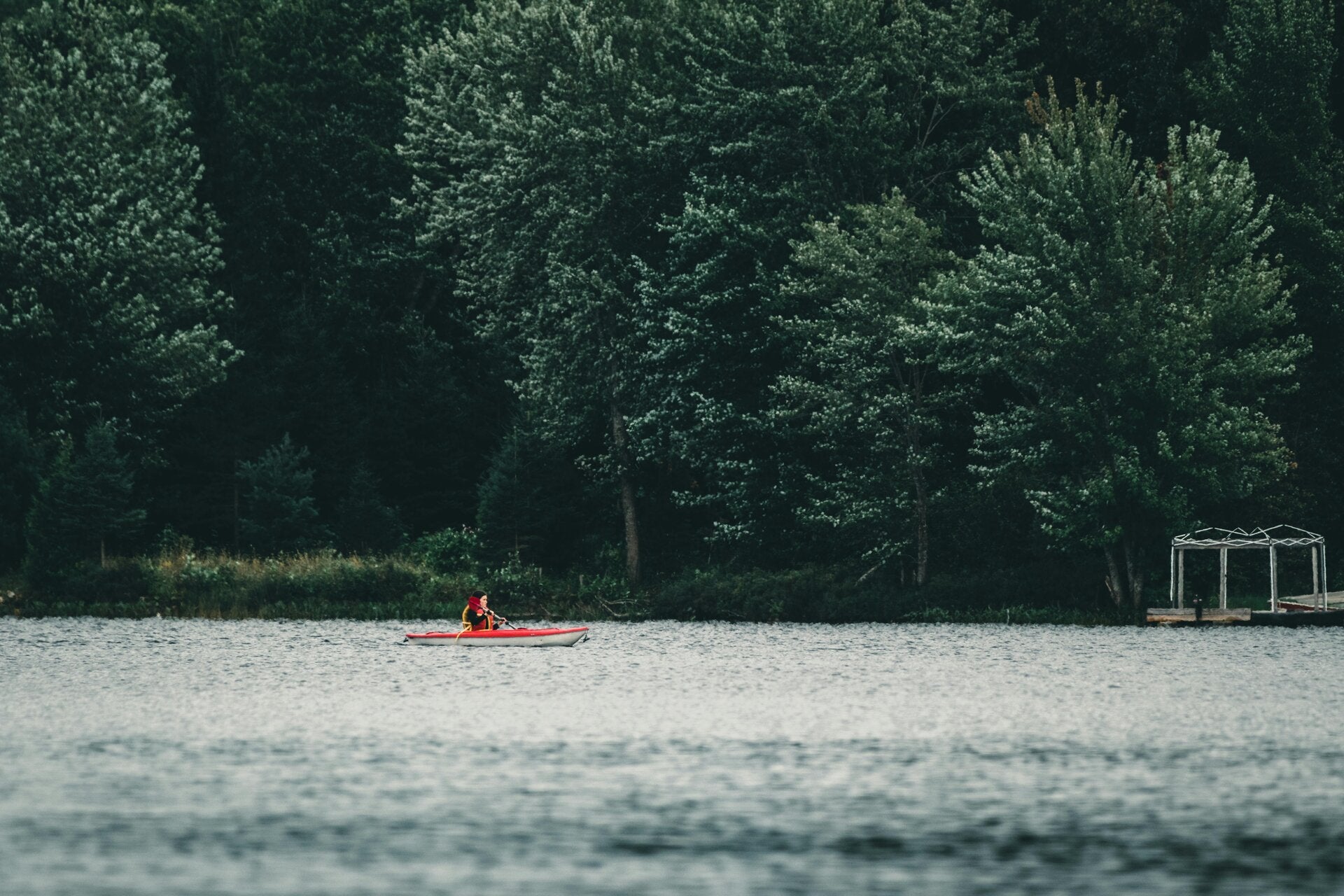
Inspiring action and adventure near H2O
Beyond reflection, this month's Written Waves aims to spark a desire for action and adventure. Bert's narratives are designed to motivate you to seek out experiences by the water, whether it’s a peaceful stroll along the shore or an exhilarating exploration of a new aquatic landscape. Embrace the call of H2O and discover how it can inspire new adventures and a renewed sense of purpose in your life.

Exploring spatial and human geography
Through his unique perspective, Bert Russell invites readers to explore the intricate connections between spatial and human geography. This August edition features captivating stories that illustrate how our environments shape our lives and how our interactions define the landscapes around us. Delve into observations that reveal the hidden beauty and complexity of the world, fostering a deeper appreciation for both natural and human elements.
WRITTEN WAVES
THE THINGS THAT STILL TURN
Some things become old. Others become memories.
August 18, 2026
www.LakeLife4U.com
This morning I saw an old blue-and-cream portable turntable sitting in the corner.
I stopped.
For whatever reason, my mind immediately went back to my first turntable.
Mine certainly wasn't portable. It was a hand-me-down, probably made sometime in the late 1960s. By the time it reached me, it already had a few quirks. Actually, "quirks" may be putting it nicely.
There was a certain broken sequence you had to follow just to make the thing work.
Turn this.
Move that.
Give it a little help.
And eventually the turntable would remember its most important job:
Turning.
Funny how I still remember that.
I also remember my first 45.
Queen.
One side had Another One Bites the Dust and the other had Don't Try Suicide.
Strangely, I remember the second song almost as much because it contained a word I wasn't accustomed to hearing growing up: damn.
That was a big deal.
Cuss words weren't casually thrown around in our house. If you heard one, somebody was usually SUPER MAD!
So there I was, listening to this little vinyl record spin around and around, hearing music—and a word—that made the world seem just a little bigger than the one I knew.
Looking at that portable turntable this morning made me wonder about its original owner.
At one time, that thing probably wasn't old.
It was probably cool.
Maybe some teenager carried it to a friend's house like a briefcase. Maybe someone in their twenties packed up a stack of records, snapped the case shut, grabbed the handle and headed somewhere for the evening.
Imagine showing up carrying your own music.
That must have felt like luxury.
Today it sits in a corner.
But it still carries something.
Memories.
Maybe that's why old things fascinate me.
Think about an old life preserver hanging inside a boathouse.
The paint is faded. The rope is worn. Maybe the lettering is barely readable. A new boater could easily walk past it and think, We need a new one.
And for actual safety equipment, we certainly want something dependable.
But that old life preserver still has another purpose.
It can be handed down.
Not necessarily to save someone's life anymore—but to tell someone about the lives that came before them.
Who held it?
What boat did it ride on?
What lake did it cross?
How many waves crashed against the side while that old preserver sat waiting?
A turntable works much the same way.
A needle touches a groove.
The record turns.
The vibration becomes a sound wave.
The sound wave reaches our ears.
And somehow, decades later, that same wave can still reach our memory.
Maybe our lives work that way too.
We inherit things from people before us—records, boats, life preservers, books, tools, stories, habits and lessons. Sometimes they're in perfect condition. Sometimes they're scratched, faded or need a little help to keep turning.
Then one day we pass them along.
A new person picks them up.
A new boater hangs the old life preserver.
A new listener drops the needle.
And another wave begins.
The waves eventually settle.
But some memories keep turning. ✌️
WRITTEN WAVES
THE GEOGRAPHY IN MY HAIR GEL
Sometimes the mind doesn’t need a road to travel. It only needs a texture.
August 17, 2026
www.LakeLife4U.com
This morning, I was doing something completely ordinary.
I put extra-firm gel in my hair.
I squeezed some into my hands and started rubbing my palms together, spreading the gel outward before running my hands through my hair.
But almost immediately, I noticed the texture.
It was thicker than the strong-hold gel I normally use. As I rubbed my hands together quickly, it became sticky. There was resistance between my palms.
And then my mind took off.
I started thinking about soil.
The thickness of the gel reminded me of different types of dirt I have felt in different places.
Pomade suddenly became red clay—the thick, heavy soil you find throughout parts of the central and southern Midwest. Dense. Sticky. Something that holds together and doesn't easily let go.
Mousse felt different in my mind.
Mousse seemed more like loose sand. Light. Airy. Soft between your fingers. It made me think of the sandy soils around San Antonio and soils I associate with warmer and more tropical regions.
Then I started thinking about all the different kinds of hair gel.
Some are almost watery.
Some are smooth.
Some are tacky.
Some grab your hands immediately.
Others slide between your fingers before becoming sticky.
Before I knew it, I wasn't styling my hair anymore—at least not mentally.
I was building a map.
I started placing different hair products across different regions based entirely on texture.
Clay here.
Sand there.
Moist soil somewhere else.
Different gels. Different soils. Different parts of the country.
And I couldn't seem to snap out of it.
For a few minutes, I wondered:
Is this weird?
Maybe.
But then I realized something.
Our minds don't always travel in straight lines.
A smell can take us back twenty years.
A song can bring someone back into the room.
A taste can remind us of a kitchen we haven't stood in since childhood.
And apparently, a handful of hair gel can send somebody traveling across a map of American soil.
That is one of the things I find fascinating about the way we think.
We experience the world through our senses, and those senses are constantly connecting today's experience with something we have touched, smelled, tasted, heard, or seen before.
The mind begins building bridges without asking permission.
One thought touches another.
That thought touches a memory.
The memory creates an image.
The image becomes an idea.
And suddenly, something completely ordinary becomes something worth thinking about.
Maybe creativity isn't always sitting down and trying to invent something.
Maybe sometimes creativity begins when we simply notice what our minds are already doing.
This morning, I noticed.
I started with hair gel.
I ended up traveling through soil, geography, texture, memory, and the strange way our minds organize the world.
All before I finished styling my hair.
THE WAVE
Not every thought has to move in a straight line to take us somewhere meaningful.
Sometimes one small sensation creates a ripple.
The ripple becomes a current.
And the current carries us somewhere we never expected to go.
Sometimes the mind doesn’t need a road to travel.
It only needs a texture.
The waves eventually settle. ✌️
www.LakeLife4U.com
Written Waves
FISHING IN THE HEAT
August 14, 2026
In the summer heat, fish search for relief beneath docks, branches and debris or in deeper, cooler water. Even the smallest fish must leave those safe places and swim into unfamiliar territory where bigger fish may be waiting.
Back-to-school can feel much the same for a child. New teachers, classrooms, classmates and expectations can make their world suddenly seem much larger.
We can't calm the entire lake for them. But we can be their dock—a safe place to return while they gain confidence and learn to navigate unfamiliar waters.
Eventually, the water becomes familiar.
The waves eventually settle. ✌️
WRITTEN WAVES
The Wave You Never Get to Ride
August 10, 2026 @ 7:51 AM
www.lakelife4u.com
Have you ever felt like you were doing everything you were supposed to do and somehow still falling farther behind?
Picture a surfer sitting just offshore somewhere along the Southern California coast.
He isn't waiting for a twenty-foot monster.
He isn't trying to become famous.
He isn't looking for the ride of his life.
He just wants one small, clean wave.
Something relaxing.
Something he can stand up on, ride toward shore, and enjoy for a few seconds.
He sees it coming.
He turns his board.
He starts paddling.
Then—CRASH!
A bigger wave rolls over him.
He surfaces, catches his breath, climbs back onto the board and starts paddling again.
Another wave.
CRASH!
That is what debt can feel like.
Maybe hardship caused you to fall behind on a bill. Maybe you made a mistake. Maybe there simply wasn't enough money to cover everything.
Eventually, a garnishment can arrive.
Money disappears from a paycheck before you ever have the opportunity to decide where it needs to go.
Now you have less money available for the bills that are still coming.
Your credit suffers.
Then damaged credit can make borrowing more expensive. Higher interest rates mean larger payments and more money spent servicing debt instead of escaping it.
Another wave.
CRASH!
You keep working.
You pay the electric bill.
You make the car payment.
You buy groceries.
You pay the credit card.
You try to save something.
You tell yourself that this month will finally be different.
Then another expense rolls toward you.
CRASH!
The frustrating part isn't necessarily that you expect someone else to erase what you owe.
You understand that bills have to be paid.
The frustration comes from feeling like the system can make recovery harder precisely when you're trying to recover.
When money is removed through garnishment, there is less available for everything else. When damaged credit leads to expensive borrowing, more of tomorrow's paycheck is committed before tomorrow arrives.
You aren't trying to buy a mansion.
You're trying to reach the shoreline.
You aren't asking for a yacht.
Maybe you're trying to own a modest home, pay off your vehicle, build some savings and finally have something that belongs to you without another payment attached.
You're waiting for that little Southern California wave.
The peaceful one.
The one where you can finally stand up, stretch your arms outward and ride.
But the ocean doesn't care how tired the surfer is.
Another set is already forming beyond the horizon.
That's the lesson I take from Written Waves.
We cannot always control the waves that come toward us.
Some are consequences of our decisions.
Some come from circumstances we never expected.
Some come from systems much larger than ourselves.
But getting knocked underwater doesn't mean we stop paddling.
A surfer learns something every time a wave rolls over him. He learns when to paddle, when to dive underneath, when to wait and when to turn the board toward shore.
Maybe financial survival is similar.
Keep learning.
Keep questioning.
Keep working.
Keep looking for calmer water.
Because somewhere between those crashing waves, there is still a small one rolling toward shore.
And maybe that is all most of us are asking for.
Not to own the ocean.
Just the opportunity to catch one peaceful wave.
✌️
THE ECHO
Have you ever felt like you were doing everything financially responsible, but every time you started getting ahead, another wave knocked you backward?
Think about it.
Then let the question travel.
Written Waves — www.lakelife4u.com
The storms eventually pass.
THE ECHOES
1st Question of the Journey!
WRITTEN WAVES
THE MARLIN, THE LURE & THE TEMU TANGLE
August 8, 2026
HAVE YOU EVER BOUGHT SOMETHING AND FELT SWINDLED?
"I HAVE" - SEE THE EXAMPLE BELOW:
There is something about open water that gets inside a fisherman.
You head offshore searching for the big one—the marlin.
You study the water. You watch the horizon. You prepare your tackle. You know that somewhere beneath that endless blue is something worth chasing.
Then you see the lure.
It flashes across the surface.
It looks irresistible.
You think, “That's the one.”
And you strike.
Welcome to the world of online bargain hunting.
THE BAIT
Temu understands something about human nature:
People love a bargain.
A price drops from $49.99 to $7.99 and suddenly the brain starts doing the math before the fingers ever reach the checkout button.
That's 84% off!
But wait.
Do I need it?
Does it actually look like the picture?
Is it really worth $49.99?
Those questions can disappear beneath the excitement of the discount.
The bargain becomes the bait.
THE TACKLE BOX
But the lure doesn't always stay on one line.
It gets cast everywhere.
TikTok.
Facebook.
Shopify.
Poshmark.
Online advertisements.
Social feeds.
One platform catches your attention. Another reinforces it. Before long, the bargain follows you around like a fisherman trolling the same stretch of water.
The discount is the lure.
The advertisement is the hook.
The social-media feed is the open water.
And the checkout button?
That's the strike.
BAM!
I've been reeled in myself.
I won't lie.
I've seen something online and thought I was getting a tremendous deal.
Then the package arrived.
And suddenly the marlin wasn't a marlin.
It was a minnow wearing a marlin costume.
The picture suggested one thing.
The product delivered something else.
The bargain wasn't necessarily the bargain I thought I was buying.
And that's where the fishing metaphor gets interesting.
WHAT ARE WE REALLY CHASING?
A fisherman goes offshore looking for a marlin.
But sometimes the excitement of the hunt becomes more powerful than the fish itself.
The same thing can happen with online shopping.
We aren't necessarily buying the product.
We're buying the feeling of getting the deal.
That's an entirely different catch.
The price tag becomes the shiny lure dancing across the water.
The bigger the discount appears, the harder it is to resist.
And somewhere beneath the surface is the question we forgot to ask:
“Would I want this if it wasn't on sale?”
THE TANGLE
Here's where the fishing line gets tangled.
Maybe the product is cheap.
Maybe the discount is real.
Maybe the seller is legitimate.
Maybe you actually found a great deal.
But when every click is surrounded by urgency, discounts, countdowns, recommendations and carefully presented pictures, the consumer has to become the fisherman—not the fish.
Slow down.
Look at the actual product.
Read the reviews.
Look at the dimensions.
Look at what you're really getting.
And most importantly:
Don't confuse the size of the discount with the value of the product.
Because a 90% discount on something you don't need is still 100% unnecessary.
THE MARLIN IS STILL OUT THERE
There is nothing wrong with searching for a bargain.
Fishermen understand the thrill of finding something worth chasing.
But the open water is full of distractions.
Not every flash beneath the surface is a marlin.
Not every lure is worth taking.
And not every bargain deserves a strike.
Sometimes the smartest fisherman is the one who looks at the lure, studies the water and says:
“Not today.”
Because the real goal isn't to catch everything that moves.
It's to know what you're actually fishing for.
And in the ocean of online shopping, that's becoming a pretty important skill.
Written Waves
Inspired by water. Guided by life.
www.lakelife4u.comThis could also become a strong newspaper-style graphic: you standing in an offshore fishing boat, rod bent over, with a giant marlin on one side—and a tangled mass of Temu-style “discount” lures floating beneath the surface.
WRITTEN WAVES
The Shower, the Toothbrush & the Shoreline
August 8, 2026 @ 6:30 AM
Yesterday was weird.
I discovered something I had apparently never questioned before: I am one of the select few who brushes my teeth in the shower.
I always assumed everybody did it.
Why wouldn't you?
I'm already there. I'm washing my body, washing my hair, shaving, using warm water and soap. So, somewhere along the way, brushing my teeth just became part of the process.
When I was a kid, I used cold water.
I don't remember exactly when I started brushing my teeth in the shower. It wasn't a decision. There was no meeting in my head where I decided, “From this day forward, I shall brush my teeth while showering.”
It just happened.
And then one day, I realized other people apparently don't do it.
That got me thinking.
I wash my dishes and eating utensils in hot water—but I do that in the kitchen.
I wouldn't wash my dishes in the shower.
I wash my body in the shower—but I wouldn't wash my body in the kitchen sink.
So perhaps the real question isn't whether brushing your teeth in the shower is normal.
Maybe the question is:
Why do we decide that some things belong in one place and not another?
And that brings me to the waves.
Every wave that reaches the shoreline is doing something remarkably simple.
It crashes.
It pulls back.
Then another comes.
And another.
And another.
The wave doesn't stop to wonder whether it is supposed to wash the sand.
It simply arrives.
Every second, the shoreline is being touched, moved, rearranged and washed again. Sand rolls. Rocks tumble. Shells shift. The shoreline changes—sometimes so slowly we don't notice, and sometimes dramatically enough that we can't miss it.
That's what repetition does.
Something we do over and over becomes familiar.
Something familiar begins to feel normal.
And something that feels normal can eventually seem like the only way to do it.
Until somebody says:
“Wait... you do WHAT in the shower?”
Maybe that's a small lesson worth carrying beyond the bathroom.
We all have habits.
We all have routines.
We all have ideas about what belongs where, what is normal, what is strange and what “everybody” does.
But sometimes our assumptions are nothing more than waves that have been washing over us for so long that we've stopped noticing them.
The shoreline doesn't argue with the wave.
The wave doesn't argue with the shoreline.
They simply interact.
One changes the other.
Maybe life works the same way.
Perhaps we don't have to fight every difference we encounter.
Maybe we can simply notice it.
Someone brushes their teeth in the shower.
Someone else thinks that's strange.
Neither person has to be wrong.
And somewhere between the two viewpoints, another wave reaches the shore.
Written Waves
Sometimes the smallest things we do reveal the biggest things we assume.
So tomorrow morning, while you're brushing your teeth—wherever you happen to be—ask yourself:
What is something I do simply because I've always done it?
And then ask:
What else might I be doing without ever questioning why?
The waves keep coming.
The shoreline keeps changing.
And perhaps we should, too. ✌️
- Bert Russell
WRITTEN WAVES
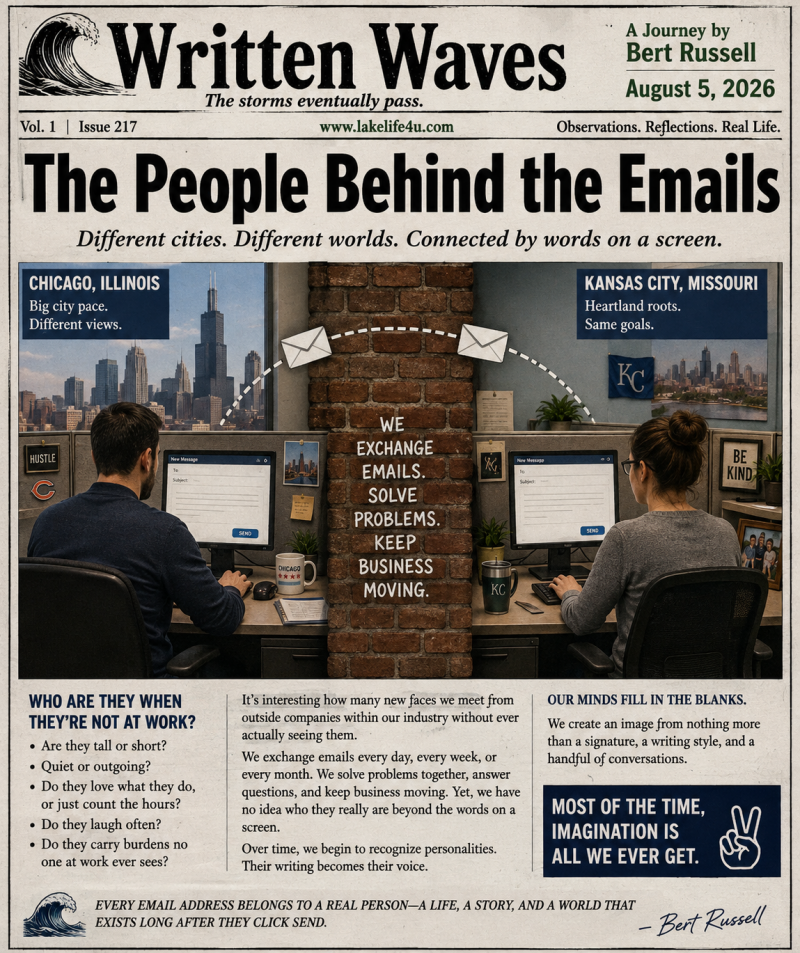
The People Behind the Emails
August 5, 2026 @ 1:29 PM
It's interesting how many new faces we meet from outside companies within our industry without ever actually seeing them.
We exchange emails every day, every week, or every month. We solve problems together, answer questions, and keep business moving. Yet, we have no idea who they really are beyond the words on a screen.
Over time, though, something unexpected happens. You begin to recognize personalities. You learn who's patient, who's direct, who's quick to respond, who's always willing to help, and who's constantly under pressure. Their writing becomes their voice.
Sometimes I wonder what they look like or how they act when they leave work. Are they tall or short? Quiet or outgoing? Do they love what they do, or are they simply counting the hours until the weekend? Are they respected by those around them? Do they laugh often? Do they carry burdens no one at work ever sees?
Our minds naturally fill in the blanks. We create an image from nothing more than a signature, a writing style, and a handful of conversations.
Most of the time, imagination is all we ever get.
Then, every once in a while, life gives you the chance to meet one of those people in person. Sometimes they're exactly as you imagined. More often, they're nothing like you expected.
Maybe that's one of the quiet reminders that every email address belongs to a real person—a life, a story, and a world that exists long after they click Send.
✌️
Written Waves
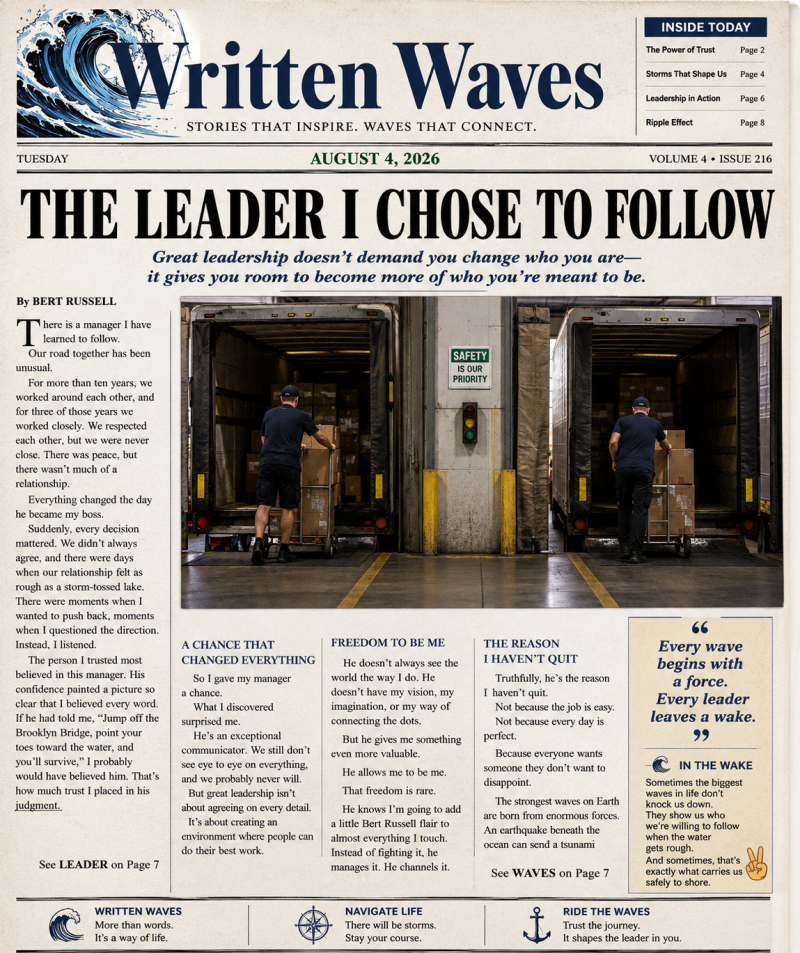
The Leader I Chose to Follow
August 4, 2026 @ 1:09 PM
There is a manager I have learned to follow.
Our road together has been unusual.
For more than ten years, we worked around each other, and for three of those years we worked closely. We respected each other, but we were never close. There was peace, but there wasn't much of a relationship.
Everything changed the day he became my boss.
Suddenly, every decision mattered. We didn't always agree, and there were days when our relationship felt as rough as a storm-tossed lake. There were moments when I wanted to push back, moments when I questioned the direction.
Instead, I listened.
The person I trusted most believed in this manager. His confidence painted a picture so clear that I believed every word. If he had told me, "Jump off the Brooklyn Bridge, point your toes toward the water, and you'll survive," I probably would have believed him. That's how much trust I placed in his judgment.
So I gave my manager a chance.
What I discovered surprised me.
He's an exceptional communicator. We still don't see eye to eye on everything, and we probably never will. But great leadership isn't about agreeing on every detail. It's about creating an environment where people can do their best work.
He doesn't always see the world the way I do. He doesn't have my vision, my imagination, or my way of connecting the dots.
But he gives me something even more valuable.
He allows me to be me.
That freedom is rare.
He knows I'm going to add a little Bert Russell flair to almost everything I touch. Instead of fighting it, he manages it. He channels it. He trusts it enough to let it exist while still holding me accountable.
Truthfully, he's the reason I haven't quit.
Not because the job is easy.
Not because every day is perfect.
Because everyone wants someone they don't want to disappoint.
The strongest waves on Earth are born from enormous forces. An earthquake beneath the ocean can send a tsunami racing across thousands of miles. A powerful hurricane can stir the sea into waves taller than buildings.
Those waves weren't created by one moment.
They were created by pressure.
Leadership works much the same way.
Pressure reveals character. It exposes weaknesses, but it also creates strength. A steady leader doesn't stop the storm. He teaches others how to navigate through it.
Sometimes the biggest waves in life don't knock us down.
They show us who we're willing to follow when the water gets rough.
And sometimes, that's exactly what carries us safely to shore.
"Every wave begins with a force. Every leader leaves a wake." ✌️
Written Waves
This weekend became another unforgettable adventure.
We left Blue Springs with a mission to explore southeastern Missouri. The original plan was to visit Pineville and Powell, looking at affordable acreage and imagining what off-grid living might be like.
Then life took one of its unexpected turns.
We kept driving, following the road wherever it led, and before we knew it, we were just 17 miles from Bentonville, Arkansas. At that point, there was only one logical choice—we kept going.
Instead of sticking to a plan, we spent the day wandering through the rural communities of northwest Arkansas and Rogers. There was no itinerary, no schedule, just curiosity leading the way. We stopped at thrift stores, roadside antique shops, and flea markets, finding little treasures and enjoying every unexpected stop along the journey.
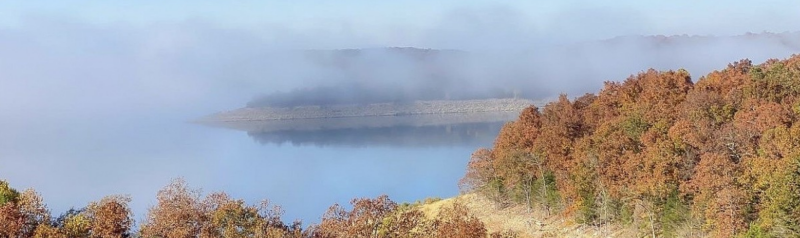
The adventure was peaceful, exciting, and unforgettable. We stood in awe of breathtaking landscapes and rock formations that have existed for millions of years. There's something humbling about seeing nature that has stood the test of time.
One thing that caught my attention was the number of Texas and Oklahoma license plates. In fact, we saw more Texas plates than Arkansas or Missouri plates, which I found fascinating. I probably should have counted the trucks, too. There were countless Chevrolets and Toyota Tundras, but surprisingly few Dodges, Nissans, or Fords. I also noticed very few Jeeps, which seemed unusual considering how many you see throughout Missouri.
The area was filled with fishing boats, personal watercraft, kayaks, and river rafts, yet we hardly spotted any canoes. It was another reminder that every region has its own outdoor culture.
Another interesting observation was the cost of living. Food and gas were noticeably less expensive than back home in Missouri, while tobacco products were significantly more expensive.
What started as a simple drive through Missouri became an incredible day exploring a beautiful corner of the Ozark Mountains. Sometimes the best adventures aren't planned—they simply happen when you follow the road instead of the itinerary.
This trip gave us plenty of memories, a few surprises, and another reminder that the journey is often more rewarding than the destination.
✌️ - Bert Russell
August 2nd @ 8:36 PM